
On-page SEO guide 2026 is the foundation of every successful SEO strategy. Even if a website has strong backlinks and good technical SEO, it will still struggle to rank if the content on the page doesn’t clearly explain what’s its about or provide real value to users.
The on-page elements aren’t strong enough or are poorly optimized. Basically, search engines use on-page signals to identify what your page is about and whether it actually adds value for users.
In 2026, Google places a strong emphasis on relevance, helpful content, and user experience. Today On page SEO isn’t just about stuffing keywords to a page. It is about creating content that clearly answers user questions, matches search intent, and delivers real value in a simple and readable way.
This on page SEO is written for anyone who wants to improve their website’s visibility in search engines. Whether you are a beginner or have some SEO experience, this guide focuses on practical, easy-to-follow steps that help improve rankings, increase clickthrough rates, keep users engaged, and build long-term organic visibility—without technical complexity. This On-page SEO guide 2026 explains how to optimise content for relevance, user experience, and long-term rankings.
What Is On-Page SEO? (On-Page SEO Guide 2026)
On page SEO is the process of optimizing individual web pages to improve their visibility in search results and attract targeted organic traffic. It focuses on improving content quality, page structure, HTML elements, and user experience.
Unlike off-page SEO that depends on backlinks, and technical SEO which focuses on crawling and indexing, on-page SEO is within your control. Proper execution improves content clarity for search engines and builds trust, readability, and value for users.
Complete On-Page SEO Guide 2026: Step-by-Step Checklist
1. Search Intent Validation
Search intent is the base of good on-page SEO. Before optimizing a page, you must clearly understand why a user is searching for a keyword. If your content does not match intent, rankings will be difficult—no matter how strong your backlinks or technical SEO may be. Start by searching your target keyword on Google. Review the top search results and observe the content style that appears repeatedly. Seeing long guides, step-by-step tutorials, list posts, comparison pages, or product pages helps you understand what users are expecting.
Next, understand the purpose behind the keyword:
- Informational: Users are looking for reliable information or answers
- Commercial: Users are researching and comparing choices
- Transactional: Users already know what they want and are ready to buy or take the next step
- Navigational: Users want a specific brand or webpage
Your content should match the style and level of detail users expect. When search intent is properly matched, all other on-page SEO efforts work more smoothly and deliver better results.
2. Keyword Mapping & Topic Strategy
Keyword mapping makes sure that each page on your website has a clear goal. Each page should target one main keyword, along with supporting keywords, similar terms, and related phrases.
Rather than using the same keyword repeatedly, work on covering the topic as a whole. This means answering related questions, explaining connected concepts, and naturally using variations of your main keyword. This helps search engines grasp the topic and prevents keyword stuffing.
Proper keyword mapping also stops keyword cannibalization, which happens when several pages compete for the same keyword. Giving each page a clear focus makes your website more organized and easier for search engines to understand.
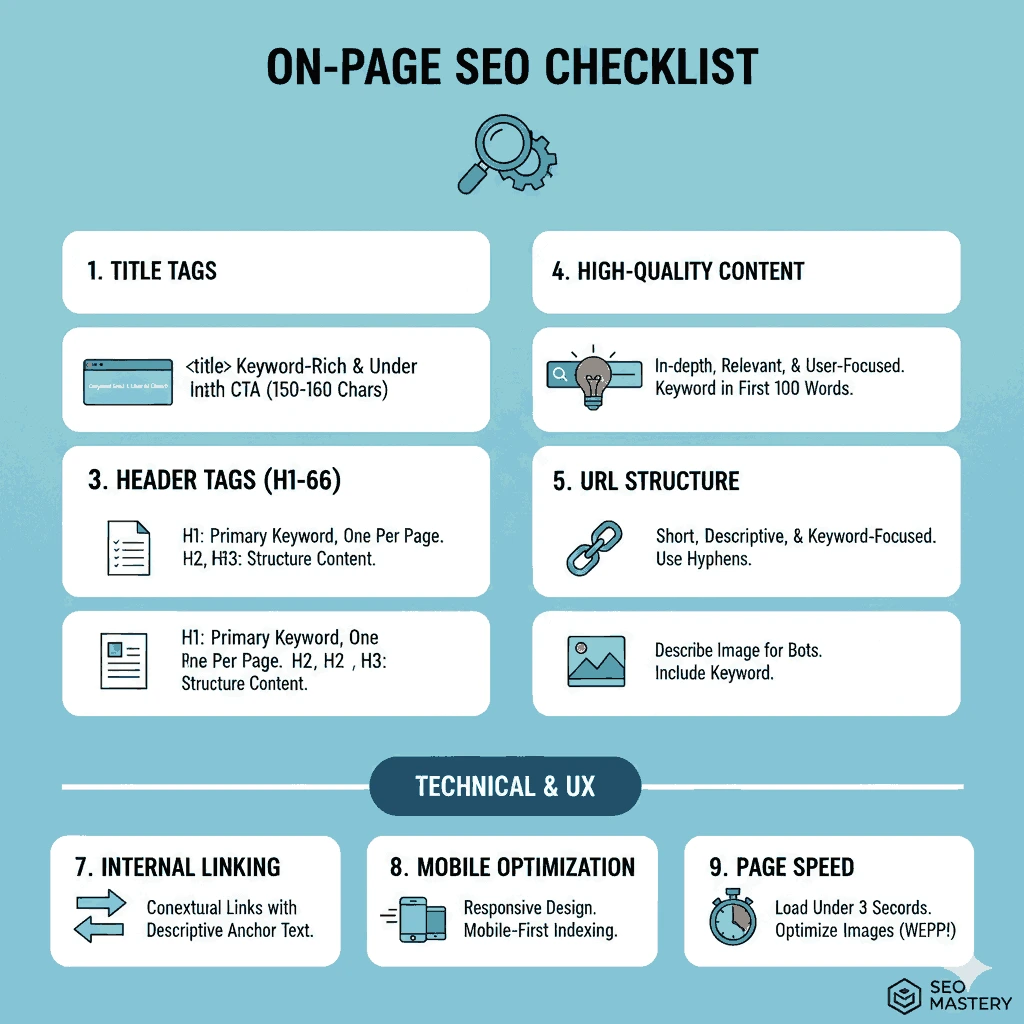
3. Title Tag Optimization (Front-Load the Keyword)
The title tag is one of the most influential elements in on-page SEO . It plays a major role in both rankings and click-through rate.
A well-optimized title makes it clear what the page is about while also attracting attention. Try to place your main keyword near the beginning and keep the title within 50–60 characters and avoid unnecessary words.
Using modifiers such as Best, Checklist, Guide, Step-by-Step, or the current year can make your title stand – out and compete more effectively in search results.
4. Meta Description Optimization
Meta descriptions may not directly influence rankings but they play a big role in improving click-through rates. A well-written meta description works as an advertisement for your page.
It should clearly explain what the page offers and why users should click. Keep it between 150 and 160 characters and use the primary keyword naturally and emphasize the benefit users will get rather than just listing features.
Make sure every page has its own unique meta description. Each page should have a unique purpose and message. Reusing the same text across multiple pages can confuse both search engines and users.
5. SEO-Friendly URL Structure
A clear and readable URL helps both search engines and visitors quickly understand what your page is about. When your URLs are simple and descriptive, they build trust, improve usability, and support stronger SEO performance. Short URLs usually perform better in search results. Include the main keyword and remove unnecessary words. Avoid special characters, and always use hyphens to separate words.
6. Smart Keyword Placement: Start Early, Keep It Natural
Search engines don’t just look at what you write, it analyses how content is structured and where keywords appear.
One of the simplest on-page tips is placing your primary keyword near the start of the article Aim to place within the first 100–150 words of your content, but make sure it blends naturally into the sentence. This early placement helps both users and search engines to confirm the topic and assures that they are in the right place. But avoid forcing keywords into sentences. Using synonyms and related phrases throughout the content further strengthens topical relevance.
7. Heading Tag Optimization
Headings play an Important role in organizing content and help readers move smoothly through the page. They also give search engines clear context about what each section is about.
Use one strong, clearly defined H1 that represents the main topic and naturally includes your primary keyword. Organize your content into sections using H2 headings and use H3’s to expand on supporting ideas. Add keyword variations to subheadings when it feels natural. Well-planned headings make your content easier to read, more accessible, and more likely to perform well in search results.
8. Content Quality
In 2026, Google places greater value on content that is genuinely helpful, original, and detailed. Instead of rewriting the existing articles, focus on adding information that improves understanding. Explain concepts clearly, provide real-world examples, introduce frameworks, and include steps users can put into action.
This concept is known as information gain– offering something new or better and delivering insights that are clearer and more helpful than competing pages. It matters far more than just increasing the word count.
9. Content Formatting for User Experience
Even high-quality content can fail if it is difficult to read or scan.
Break your text into short and readable sections. Use short paragraphs, bullet points, numbered lists, and bold text to highlight key ideas. For long articles, a table of contents improves navigation and keeps users engaged.
Good formatting reduces bounce rate and encourages visitors to spend more time on your page
10. Multimedia Optimization
Visuals help users understand information more quickly and engage with your content. Use images, charts, screenshots, and infographics when they add insight or support the content. Skip visuals that don’t add value or are only for show. When used wisely, visuals simplify complex ideas, hold attention longer, and improve the overall user experience.
11. Image SEO Best Practices
Images should improve your content without slowing it down.
Use clear and descriptive file names, add meaningful ALT text for accessibility, compress images to reduce load time, and enable lazy loading where possible. ultimately, these steps improve page speed and create a smoother browsing experience.
12. Internal Linking Strategy
Internal links help search engines to crawl your website and recognize how individual pages are linked by topic. Use relevant and descriptive anchor text so both readers and search engines know what to expect when they click.
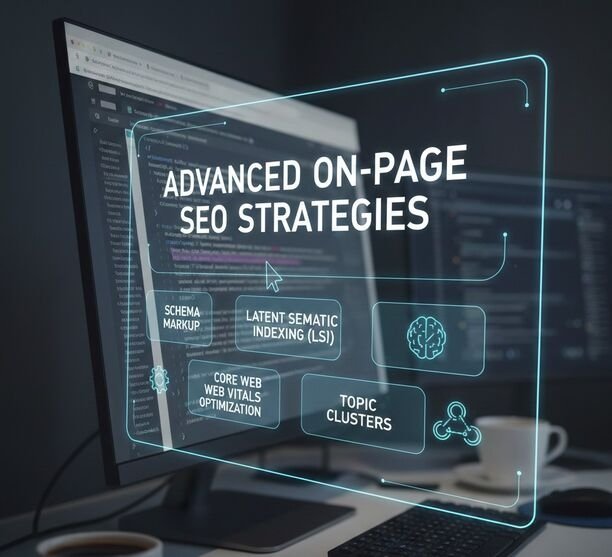
Connect important pages from strong, high-performing (authoritative) content and organize your site into topic clusters. Accordingly, this strengthens your website’s credibility around main topics.
13. External Linking for Credibility
External links boost your site’s credibility and establish trust and context. Always Link to reliable and relevant sources to support facts, statistics and references. Avoid overloading your pages with too many outbound links and ensure all links add value to the reader.
14. Mobile Optimization
Since Google focuses on mobile-first indexing, your site’s mobile version plays the main role on how it ranks. Make sure your site is easily adjustable to all screen sizes, text is easy to read without zooming, and buttons are simple to tap. A fast and user-friendly mobile experience is essential for both SEO and visitor satisfaction.
15. Page Speed & Core Web Vitals
Website page speed directly impacts both user experience and SEO performance.
To improve speed and optimize images and scripts, minify CSS and JavaScript files, use caching and CDN whenever possible. Monitor Core Web Vitals such as LCP, CLS, and INP. Faster pages help to keep visitors engaged and boost your search rankings.
16. Schema Markup
Schema markup helps search engines a better understanding of your content. Adding article schema, FAQ schema, and breadcrumb schema can make your pages stand out in search results and improve click-through rate when used correctly.
This step-by-step On-page SEO guide 2026 focuses on practical actions that matches with how Google evaluates website pages today.
By following this On-page SEO guide 2026, you can build pages that rank consistently and deliver real value to users.
Advanced On Page SEO Strategies
Content Freshness Optimization
Search engines support content that stays accurate and relevant over time. Up to Date your articles by refreshing outdated information, refresh statistics, add new sections, and review key pages every 6–12 months. Maintaining content freshness helps maintain rankings and authority.
On Page SEO for AI & LLM Visibility
AI-powered search engines perform best when your content is simple, organized and easy to read. Concentrate on giving short, direct answers, adding definition-style sections, and including helpful FAQs. Write the way people actually speak. When your content aligns with conversational search queries, it becomes easier for AI tools to understand and recommend it.
Common On-Page SEO Mistakes to Avoid
Many websites lose traffic for the reasons like keyword stuffing, not matching the content to what users actually want, publishing duplicate content or forgetting to connect pages with internal links and over-optimized headings. Avoiding these mistakes is important as applying best practices.
Why This On-Page SEO Guide 2026 Matters in Modern Search
On-page SEO is not just a one-time job. It’s an ongoing process that requires regularly reviewing pages, updating content, fixing issues, adapting to changing search trends, and improving user experience over time. When you follow this on-page SEO checklist, you can create pages that rank better, keep users engaged, and achieve long-term organic growth. Whether you’re a business owner, blogger, or freelance digital marketer, applying these strategies consistently will help you build stronger visibility and trust in search results.
Need help optimising your website the right way?
I help businesses implement proven on-page SEO strategies that improve visibility, engagement, and conversions.